If you invoice clients abroad in dollars — as a SaaS founder, an IT services company, a freelance consultant, or an export-oriented BPO — there’s a compliance change headed your way that most of your accountant’s checklists haven’t caught up with yet.
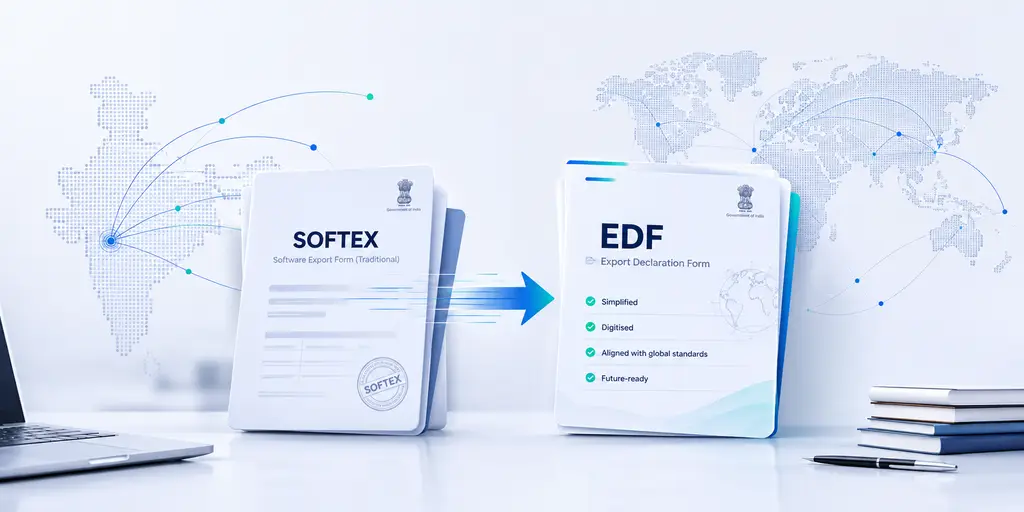
From October 1, 2026, the SOFTEX form — the declaration Indian software and IT/ITeS exporters have filed for over two decades — stops existing as a separate process. It gets absorbed into a single, unified Export Declaration Form (EDF) that every exporter of goods, services, and software will use to report the same thing: that money is owed to you from outside India, and RBI needs to track it until it lands in your bank account.
This isn’t a minor form update. It’s a rewrite of the legal plumbing behind how India monitors export earnings, and it changes who certifies your exports, how often you file, and what happens if you don’t.
The Regulation behind the change
The Reserve Bank of India notified the Foreign Exchange Management (Export and Import of Goods and Services) Regulations, 2026 — Notification No. FEMA 23(R)/2026-RB — on January 13, 2026, followed by A.P. (DIR Series) Circular No. 20 on January 16, 2026, laying out the operating directions for banks. These 2026 Regulations come into force on October 1, 2026, and on that date they supersede the Foreign Exchange Management (Export of Goods & Services) Regulations, 2015, along with the Master Directions on Export and Import of Goods and Services that banks have relied on since.
Until then, the old regime — SOFTEX filed through STPI or SEZ authorities, EDF filed for goods, GR/PP/SDF forms for other categories — continues to run in parallel. Nothing changes for you today. The changeover is a hard cutover on a fixed date, not a gradual phase-in, so exporters who wait until September to figure out the new process will be doing it under time pressure.
What’s actually changing
One form for everything. Under the 2015 framework, exports were declared differently depending on what left the country: a shipping bill and EDF for physical goods, SOFTEX for software and IT-enabled services, and separate forms for a handful of other categories. The 2026 Regulations fold all of it into one EDF. Regulation 2(1)(f) of the new rules explicitly defines software as falling within the broader category of “services” for reporting purposes — so a company exporting a SaaS subscription and a company exporting consulting hours will, from a compliance standpoint, be doing the same thing.
Who certifies the export changes. This is the part software exporters should pay closest attention to. Historically, STPI (or the relevant SEZ authority) was the sole “Specified Authority” empowered to certify a software export before it could be reported to RBI — a step that routinely added processing delays, especially for smaller companies without an in-house compliance team chasing STPI officers. Under the new Regulation 2(1)(f), the definition of Specified Authority is split by category and location: for goods, it’s the Commissioner of Customs (in the Domestic Tariff Area) or the Development Commissioner (in an SEZ); for services and software exported from the DTA, it’s now the exporter’s own Authorised Dealer (AD) Bank, standing alongside STPI rather than being replaced by it. In practice, this means a DTA-based software exporter can get export declarations certified directly by their bank instead of routing everything through STPI — assuming the bank’s internal process supports it, since RBI has left banks to work out their own SOPs for this.
Filing goes from per-invoice to monthly. SOFTEX was traditionally filed per invoice or in periodic batches capped at a 90-day invoice window through the SEZ Online portal. Under the unified EDF, the RBI notification text is explicit: an exporter of services must furnish the EDF within 30 days from the end of the month in which the invoice for services was raised, and multiple invoices from the same month can be consolidated into a single filing. If you invoiced a US client on the 3rd and a UK client on the 27th of the same month, both go into one EDF, due by the end of the following month.
Banks are now on the clock too. Once you’ve filed, the AD bank has 5 working days to upload the EDF into EDPMS (the Export Data Processing and Monitoring System) — the RBI’s system of record for tracking whether export value has actually come back into India. This matters more than it sounds like it should, because EDPMS entries are what your bank checks before releasing FIRCs, and what determines whether an outstanding export shows up as “overdue” on your compliance record.
Nil-value exports get simpler. If you’re sending free samples, trial access, or a proof-of-concept build with no invoice value, you previously needed separate RBI permission. Now you file a nil-value EDF instead — one less approval to chase.
Realisation timelines have been extended. Separately, but relevant to the same compliance calendar, RBI had already extended the period within which export proceeds must be realised and repatriated from 9 months to 15 months (Notification No. FEMA 23(R)/(7)/2025-RB, November 13, 2025), and that extended window carries into the 2026 Regulations. Exports invoiced or settled in Indian Rupees get an additional 3 months on top of that.
Who this actually affects
If you’ve been filing SOFTEX because you run an IT company, an ITeS/BPO operation, or a SaaS business, the change is largely procedural — same underlying disclosure, different form and certifying authority.
The bigger shift is for exporters who were not filing anything at all. A meaningful share of independent consultants and small service agencies have historically routed their invoices under purpose code P0802 (“software implementation/consultancy not covered in SOFTEX form”) specifically because it sat outside the SOFTEX net. That gap closes under the unified regime — every service export, software or otherwise, goes through the same EDF. If you’re a freelance developer, a marketing consultant billing overseas clients, or a small agency that has been receiving payments through an OPGSP or payment aggregator without a formal export declaration, this is the first time the compliance obligation applies to you directly.
What non-compliance actually costs
This isn’t a box-ticking exercise you can quietly skip. Failure to file, or filing incorrect declarations, is a contravention under FEMA and can attract a penalty of up to three times the sum involved, under Section 13(1), with an additional continuing penalty for each day the default persists after it’s identified. Beyond the direct penalty, unfiled or mismatched EDFs show up as discrepancies in EDPMS, and banks are generally reluctant to issue a clean FIRC or process further remittances against an exporter code with unresolved EDPMS entries — which has a knock-on effect on GST refund claims and RoDTEP benefit eligibility, both of which lean on export realisation data being clean in the system.
Where this intersects with getting paid
For most service and software exporters, the EDF is downstream of a more immediate problem: actually receiving the payment in the first place, and receiving it in a form your bank can reconcile against the invoice you’re declaring. A late or mismatched inward remittance doesn’t just delay your cash flow — it complicates the EDF filing itself, since the declaration is supposed to tie back to a specific invoice and a specific realisation.
This is really the operational argument for exporters to tighten up their remittance and documentation flow well before October: a clean pipeline from invoice to FIRC to EDPMS entry makes the compliance side close to automatic, while a messy one turns every filing into a reconciliation exercise.
At HiWiPay EXIM, this is the layer we sit on — helping exporters get inward remittances in cleanly against the right invoice, with the documentation trail that banks expect, so the EDF (or, until October, your SOFTEX filing) is a formality rather than a scramble. If you’re an SME exporter trying to get ahead of the October 1 changeover, it’s worth having that conversation with your AD bank now, not in September.

This article reflects the Foreign Exchange Management (Export and Import of Goods and Services) Regulations, 2026 (Notification No. FEMA 23(R)/2026-RB, dated January 13, 2026) as publicly notified by RBI. Regulations and bank-level implementation processes may be updated before the October 1, 2026 effective date — exporters should confirm current requirements with their Authorised Dealer bank closer to the transition.
Geeta Chauhan