
Export Compliance Platform
Stay Compliant.
Let HiWiPay Manage
the Process.
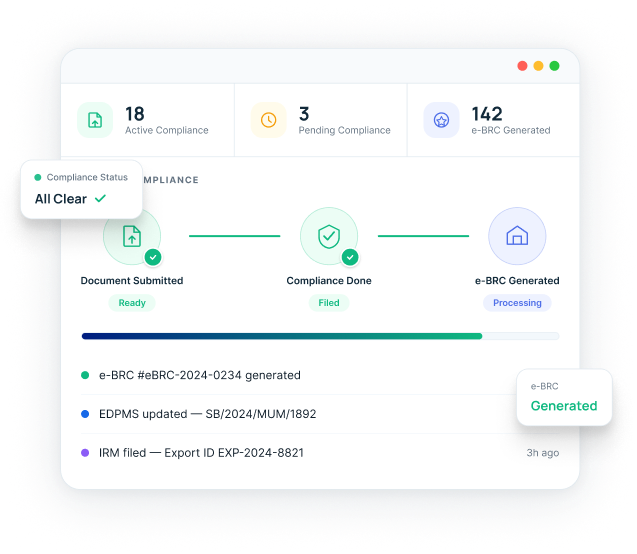
Manage your complete export compliance journey from IRM to e-BRC, in one platform. HiWiPay brings these workflows together in one digital platform.
Important RBI-FEMA Update
New Export Declaration Form (EDF) requirements take effect from 1 October 2026 and will be mandatory for exports compliance. HiWiPay helps you file and stay compliant.
Important RBI-FEMA Update
New Export Declaration Form (EDF) requirements take effect from 1 October 2026 and will be mandatory for exports compliance. HiWiPay helps you file and stay compliant.
From Complex
Processes to
One Simple Workflow

Our team will help you through the entire process.

Start Your Export
Share your shipment & export documents with us.

We Coordinate Everything
We coordinate with banks, DGFT & Customs for you.

We Handle Compliance
We manage your IRM, EDF & EDPMS requirements via partners.

We Complete the Closure
We handle regularization and close your export process via partners.

Get Your e-BRC
We complete the process and get your e-BRC ready via DGFT.
Built for Every Exporter
HiWiPay is designed for goods and service exporters, from growing businesses to large enterprises managing high volumes of export transactions.

SMEs & Growing Exporters
Simplified compliance for businesses scaling their international trade operations.

Goods Exporters
Manage IRM, shipping bill coordination, and EDPMS for physical goods exports.

Service Exporters
Export compliance management for software, consulting, and professional service exporters.
Enterprise Exporters
High-volume multi-client compliance management for large export operations.
Manage Multiple Clients from Single Platform
A
Acme Textiles Ltd
e-BRC Pending
G
Global Pharma Exports
EDPMS Closure
T
TechSoft Solutions
e-BRC Generated
E
Eastern Spice Exports
IRM Creating
Managing 4 clients · 12 active exports · 28 total transactions
For Professionals
A Compliance Platform for Professionals
HiWiPay can also be used as a multi-client compliance platform by professionals and ecosystem partners managing export processes for their customers.
- Chartered Accountants
- Custom House Agents
- Payment Companies
- Export compliance service providers
Frequently Asked Q uestions
01
Export Declaration Form (EDF)
02
Authorized Dealer Bank
03
Inward Remittance Message (IRM)
04
Export Data Processing and Monitoring System (EDPMS)
05
Electronic Bank Realisation Certificate (e-BRC)
What is EDF?
The Export Declaration Form (EDF) is a mandatory document submitted to your authorized bank to declare the value and details of goods or services exported from India under FEMA regulations.
Purpose: It acts as an official declaration to the Reserve Bank of India (RBI) that an export happened and foreign payment is expected.
Tracking: Every EDF opens a tracking record in the RBI’s Export Data Processing and Monitoring System (EDPMS).
Completion: The tracking entry closes only after the foreign payment arrives and your bank verifies it.
Benefits: Closing this entry generates an electronic Bank Realisation Certificate (eBRC), which you need to claim export incentives.
The Export Declaration Form is used to report export transactions for foreign-exchange compliance.
Why is EDF important?
EDF (Export Declaration Form) is important because it helps formally record and declare details of your export transaction. It forms part of the information used to track an export from the time goods are exported until the export proceeds are realised and the applicable compliance process is completed.
In simple terms:
Export declared → Export recorded → Payment received → Transaction reconciled → Compliance completed
EDF-related information can be important when matching the export transaction with the payment received and resolving or regularising pending export transactions.
HiWiPay helps you generate and manage EDF-based export information, payment reconciliation and regularisation workflows from one platform.
Is EDF applicable to goods or services?
EDF requirements depend on the applicable RBI regulatory framework and the type of export. Under the updated regulations effective from October 1, 2026, Export Declaration Form (EDF) requirements apply to both Goods and Services exports, with different processes and timelines depending on the nature of the export.
What happens if EDF information is wrong?
Incorrect EDF information can lead to mismatches, delays in processing or additional verification during the export compliance and regularisation process.
For example, incorrect information about:
Export value
Exporter or buyer details
Invoice details
Shipping/export details
Payment or realisation information may make it difficult to match the export transaction with the payment received.
If you identify an error, contact your AD bank or the relevant authority to understand the applicable correction or amendment process. Do not assume that an incorrect EDF will automatically be corrected.
What is EDF-based regularization?
EDF-based regularisation is the process of resolving pending or mismatched EDF export transactions and completing the applicable payment, documentation and banking requirements so the export transaction can be appropriately regularised and closed.
Our platform helps organize the information and documents required for this process. The final acceptance or closure is performed by the relevant bank or authority.
Does HiWiPay regularises EDF?
Not exactly, Under the existing framework, the AD Category-I bank has the regulatory role in processing and reporting export transactions and can regularise certain export-related cases subject to applicable conditions.
RBI’s framework explicitly assigns various regularisation powers to AD banks. HiWiPay platform is technically connected with an AD Bank and the bank performs the regulatory action based on data/case submitted through HiWiPay
What role does my bank play?
Your Authorized Dealer bank, commonly called an AD bank, handles the foreign-exchange compliance side of your export transaction.
Depending on the transaction, the bank may:
- Receive or process inward remittance information.
- Generate or make available the IRM.
- Match payment with the export transaction.
- Review invoices and supporting documents.
- Update or regularize entries in EDPMS.
- Generate or support e-BRC generation.
- Ask for clarifications or additional documents.
- AD Category-I banks maintain export records aligned with EDPMS.
What documents may the bank ask for?
The requirements vary, but common documents include:
- Commercial invoice.
- Shipping bill or export declaration.
- Purchase order or contract.
- Bank statement or remittance advice.
- Foreign inward remittance details.
- Delivery or service evidence.
- Agreement or work order for services.
- Foreign exchange conversion details.
Declaration or clarification for discrepancies.
Your bank may request additional documents depending on the transaction.
Is the platform a replacement for my bank?
No.
Our platform helps you prepare, organize, track, and submit the required information to your bank. Your bank remains responsible for:
- Verifying the transaction.
- Accepting documents.
- Processing the remittance.
- Updating applicable banking systems.
- Regularizing or closing eligible entries.
- Generating or supporting the e-BRC process.
Does the platform generate an official IRM?
The official IRM is generated or made available through the applicable banking and reporting process.
Our platform can help you:
- Capture IRM details.
- Track IRM status.
- Match IRM with invoices or EDF records.
- Identify unmatched receipts.
- Prepare information for bank submission.
- Monitor pending bank actions.
What is an IRM?
An IRM (Inward Remittance Message) is a standardized electronic notification generated by your Authorized Dealer (AD) bank the moment foreign currency lands in your account from an overseas buyer.
Think of it as the bank’s official data record that tells regulatory authorities: “We have received a cross-border payment, and it belongs to this specific exporter.
Why the IRM is Critical For You?
It settles your legal liability: Under FEMA regulations, you must account for every dollar brought into the country. The IRM is the first step to clearing your name.
It enables export incentives: You cannot get an electronic Bank Realisation Certificate (eBRC) or claim GST refunds until your IRM is successfully matched and “knocked off” against your export documents.
What if my IRM is not visible?
Possible reasons include:
- The bank has not processed the remittance.
- The payment was received recently.
- The remittance was received through another bank or provider.
- The exporter name does not match.
- The purpose code is incorrect.
- The payment has been recorded against a different reference.
- The bank needs additional documents.
Our platform helps identify the likely issue and prepares a follow-up checklist for your bank.
Can one IRM be mapped to multiple invoices?
What if the payment amount is different from the invoice amount?
Differences may occur because of:
- Bank charges.
- Exchange-rate variation.
- Partial payment.
- Deduction by the overseas customer.
- Credit note.
- Tax deduction.
- Commission.
- Short realization.
The bank may ask for a declaration, agreement, or supporting evidence before regularization.
What is EDPMS?
EDPMS means Export Data Processing and Monitoring System.
It is the system used to monitor export transactions and the realization of export proceeds.
Who manages EDPMS?
EDPMS is an RBI-related export monitoring system, but exporters usually interact with it indirectly through their Authorized Dealer bank.
Your bank reviews and updates relevant export records based on documents, payment information, and regulatory requirements. RBI’s guidance requires AD banks to update EDPMS as export proceeds are realized and generate e-BRC from EDPMS data
What does “EDPMS outstanding” mean?
An EDPMS entry is outstanding when the export record has not yet been fully matched, realized, regularized, or closed.
This does not always mean that you have done something wrong. It may be caused by:
- Payment not yet received.
- Payment received but not mapped.
- Missing documents.
- Incorrect invoice or shipping bill details.
- Partial realization.
- Bank charges or short realization.
- Amendment pending.
- Buyer or payment-reference mismatch.
- Bank processing delay.
Can the platform close my EDPMS entry?
The platform cannot independently close an official EDPMS entry unless the applicable official integration and bank process permit it.
We prepare and manage the workflow. The Authorized Dealer bank performs the applicable verification and closure.
Why does EDPMS status matter for exporters?
EDPMS data affects the ability to demonstrate export realization and supports the e-BRC process.
What is e-BRC?
Why is e-BRC important?
e-BRC helps exporters maintain evidence of export proceeds realised and may be required for certain DGFT-related export benefits, incentives or compliance processes, depending on the applicable transaction and scheme
Who is involved?
Exporter: Provides and maintains the relevant export and transaction information.
AD Bank: Processes the applicable export proceeds and banking realisation information.
DGFT: Portal to generate e-BRC and uses the information for applicable foreign trade processes.
HiWiPay: Helps you track the export transaction and manage the workflow towards compliance closure.
How does HiWiPay help?
HiWiPay helps you:
- Track export transactions
- Monitor payment realisation
- Identify pending compliance actions
- Track IRM and EDPMS-related workflows
- Manage export regularisation cases
- Monitor e-BRC status
HiWiPay helps simplify the journey from export payment realisation to compliance closure.
What should a service exporter maintain?
Typical records may include:
- Export invoice.
- Client agreement or work order.
- Statement of work.
- Proof of service delivery.
- Foreign inward remittance details.
- IRM information.
- Bank statement or remittance advice.
- GST invoice.
- SAC code.
- Purpose code.
- EDF or applicable declaration.
- Email or contractual evidence.
Is e-BRC applicable to service exporters?
You Manage Your Business.
We Manage the Process.
Let HiWiPay manage the complexity of export compliance while you focus on growing your global business.
Get in Touch !
Tell us about your business and our team will contact you to discuss the integration.
- +917670998508
- exim@hiwipay.com
- 802, B Wing, 8th floor, Naman Midtown, Senapati Bapat Marg, Near India Bulls, Dadar West, Mumbai, MH 400028



Thank you for your interest in HiWiPay.
We’ve received your request. Our team will review your requirements and contact you to discuss the integration and next steps.