There’s a quiet kind of experiment that plays out every week across India.A freelancer finishes a project for a client abroad — the logo ships to Berlin, the code runs in New York, the video streams in Dubai.Then comes the real test: getting paid.
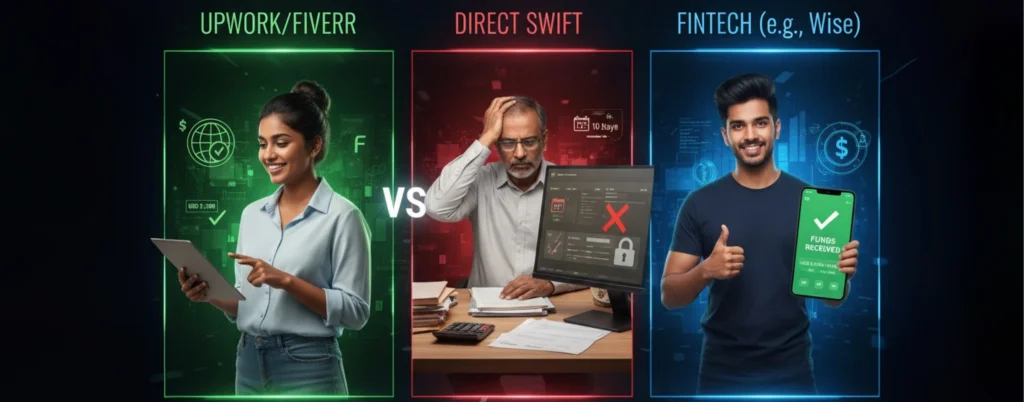
One week it’s an Upwork payout. The next, a Fiverr transfer. Sometimes, a direct SWIFT wire that takes its own sweet time crossing oceans.Same work, same effort — three completely different results in rupees.
If you’ve ever wondered why your creativity travels faster than your money, this article is for you.
We’re comparing the three main ways Indian freelancers receive USD — **Upwork, Fiverr, and direct bank SWIFT** — to find out which one actually respects your time, your work, and your wallet.
The Freelancer’s Universal Question — “Where Did My Dollars Go?”
Freelancers live in a world where every dollar earned passes through at least one layer of conversion, fees, and delay before it becomes usable INR.Each platform calls it a “simple payout.” But behind the simplicity are quiet markups — the kind that never appear on your invoice.
This isn’t about which platform you work on. It’s about which one lets you **keep** more of what you earn.
The Three Main Routes — Marketplace Wallets or Direct Transfers
| Route | Who It’s For | Typical Partners | Core Advantage | Hidden Catch |
|---|---|---|---|---|
| Upwork Payouts | Freelancers using Upwork | Payoneer, Wise, Bank transfer | Seamless workflow | FX markups and service fees |
| Fiverr Payouts | Creatives and agencies | Payoneer, PayPal | Fast, integrated | Double conversion layers |
| Direct SWIFT | Independent freelancers | Bank wire | Control, independence | High fixed charges, slow FIRCs |
All three routes work. The real difference lies in how much of your $1000 actually reaches you — and how long it takes.
Upwork Payouts — Convenient but Costly
Upwork makes getting paid easy: you click “Withdraw,” and your funds move to Payoneer, Wise, or directly to your bank. It’s neat, automated, and efficient — until you do the math.
How It Works
* Upwork deducts its service commission (10–20%) before releasing the payment.
* The payout partner applies its own conversion rate and transaction fee.
* The result is a quiet 6–8% haircut on your actual income.
Example: $1000 Upwork Payout
| Step | Amount | Deduction | Final |
|---|---|---|---|
| Upwork Earnings | $1000 | –$100 (Upwork fee) | $900 |
| Payoneer FX Spread | 2% | –$18 | $882 |
| INR Received (₹82/$) | — | — | ₹72,324 |
Verdict: Upwork’s payout flow is smooth but pricey. You’re paying for ease with every withdrawal.
Fiverr Payouts — Fast, but Fees Stack Up
Fiverr promises instant withdrawals — and it delivers. But that speed comes at a quiet cost.
How It Works
Example: $1000 Fiverr Payout
| Step | Amount | Deduction | Final |
|---|---|---|---|
| Fiverr Earnings | $1000 | –$50 (fee) | $950 |
| Payoneer/PayPal FX Spread | 2.5% | –$23.75 | $926.25 |
| INR Received (₹81.8/$) | — | — | ₹75,787 |
Verdict: Fiverr gets your money home fast, but trims 5–6% on the way. You pay for speed with your own income.
Direct SWIFT Transfers — Classic, Expensive, Slow
Direct SWIFT transfers feel professional — until you realize the bank, its partners, and their partners all charge a fee somewhere along the chain.
How It Works
* Your client initiates a SWIFT transfer to your Indian bank.
* Intermediary banks take $10–15.
* Your bank charges $25–40 for inbound processing.
* Conversion happens at a rate 50–75 paise lower than market.
Example: $1000 SWIFT Transfer
| Step | Amount | Deduction | Final |
|---|---|---|---|
| Client Transfer | $1000 | –$30 (intermediary + bank fee) | $970 |
| Bank FX Rate | ₹81.5/$ | — | ₹78,055 |
| FIRC Fee | ₹300–₹500 | — | ₹77,700 (net) |
Verdict: SWIFT transfers give you independence but not efficiency. The network is global; the process still feels local and slow.
FIRC, Compliance, and the Tax Reality
Most freelancers only hear the word *FIRC* in March — when their accountant asks for it. But how your platform handles compliance decides how smooth your tax filings will be.
| Platform | FIRC Handling | Ease |
|---|---|---|
| Upwork via Payoneer | e-FIRC on request | Medium |
| Fiverr via Payoneer/PayPal | FIRC via partner bank | Complex |
| Direct SWIFT | Physical FIRC | Manual |
| Fintech (HiWiPay) | Auto e-FIRC | Instant |
Upwork and Fiverr make earning easy. But fintechs like HiWiPay make keeping it clean.
Which Route Actually Gives You More INR?

| Method | USD Sent | Fees/Spread | Approx INR Landed | Time Taken |
|---|---|---|---|---|
| Upwork → Payoneer | $1000 | ~7–8% | ₹72,000–₹74,000 | 1–3 days |
| Fiverr → Payoneer/PayPal | $1000 | ~5–6% | ₹75,000–₹76,000 | 1–2 days |
| Direct Bank (SWIFT) | $1000 | ~3–4% + flat fee | ₹77,000–₹78,000 | 3–5 days |
| Fintech (HiWiPay) | $1000 | <1% | ₹82,000+ | 1 day |
It’s not about where you work — it’s about where your money rests.
Pros and Cons Summary
| Feature | Upwork | Fiverr | Bank SWIFT |
|---|---|---|---|
| Ease of Setup | High | High | Moderate |
| Speed | Fast | Fastest | Slow |
| Transparency | Medium | Low | Low |
| Cost Efficiency | Poor | Average | Moderate |
| FIRC Handling | Manual | Manual | Manual |
| Best For | Platform-only freelancers | Short-term gigs | Direct client projects |
Verdict — Stop Letting Platforms Decide Your FX
Freelancers fight hard for every project — but most never fight for their payout efficiency.
If you’re losing 5–8% in hidden costs every month, that’s not “fees.” That’s lost income.
Convenience isn’t free. The smarter freelancers are now optimizing their payout paths just like they optimize their client funnels. You negotiate your project terms — it’s time to negotiate your payment terms too.
In Summary
Upwork and Fiverr made it easy to find clients.But **HiWiPay** makes it easy to keep what you earn.
HiWiPay gives Indian freelancers global virtual accounts in 25+ currencies, zero hidden FX markups, instant e-FIRC generation, and full RBI compliance — all in one dashboard.
No middlemen, no mystery math, no lost rupees.
Up next: HiWiPay vs Wise — Real Landed INR Explained.
Because what matters isn’t what you billed — it’s what finally landed.