The euro doesn’t behave like the dollar.It moves through different networks, follows different rules, and arrives in India with a personality of its own.
For Indian IT service firms working with clients across Europe, that difference shows up not in code quality, but in cash flow.You can deliver a perfect sprint, ship every milestone on time — and still lose a few thousand rupees in fees and conversion spreads, simply because your EUR took the wrong route home.
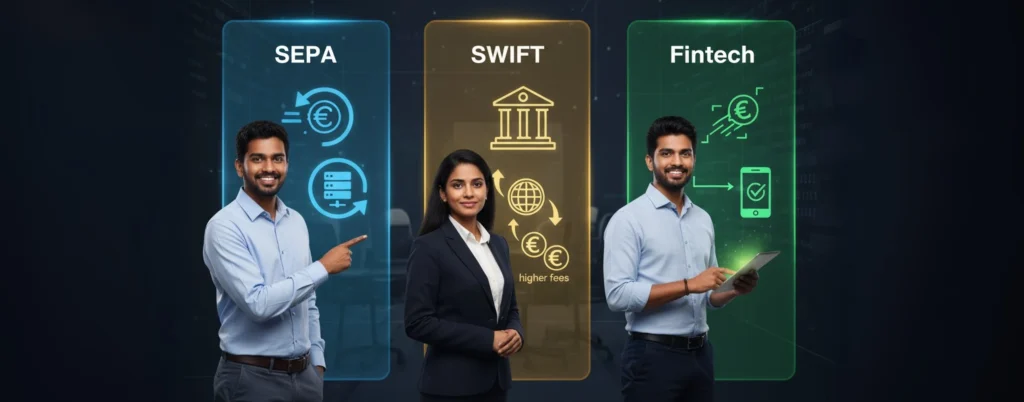
There are three main paths that money can take: SEPA, SWIFT, and fintech-led cross-border payment platforms. Each has its believers. Each has its cost. The goal isn’t to pick a favorite, it’s to see which one respects your invoice the most.
Why EUR Receipts Deserve Their Own Playbook
Most Indian exporters treat EUR just like USD — same invoice, same bank, same wire. But Europe plays by its own rules.
- The SEPA network (Single Euro Payments Area) is Europe’s domestic transfer system — cheap, fast, but mostly inward-facing.
- SWIFT is the international default — global reach, slower speed, higher cost.
- Fintech platforms bridge the two, connecting European clients to Indian accounts without passing through the maze of correspondent banks.
If your clients are in Germany, France, or the Netherlands, choosing the right channel isn’t a technical decision — it’s a profitability one.
The Three Routes — What Actually Happens Behind the Scenes
| Route | Origin Network | Typical Fee | Settlement Time | Core Issue |
|---|---|---|---|---|
| SEPA | Eurozone (intra-EU) | €0–€5 | 1–2 business days | Not designed for non-EU banks |
| SWIFT | Global | €25–€40 + FX markup | 3–5 business days | Multiple intermediaries, higher cost |
| Fintech Platform | Hybrid (SEPA + local rails) | <1% | 24–48 hours | Transparent, direct, RBI-compliant |
SEPA Transfers — Great for Europe, Not Built for India
The “Single Euro Payments Area” is one of the most efficient payment systems in the world — inside Europe. A SEPA transfer between Paris and Berlin often costs less than a coffee and settles within hours.
The moment you add “India” to the recipient field, things change. SEPA isn’t meant for cross-currency settlement. Your European client’s bank converts EUR to USD, passes it through a SWIFT leg, and your Indian bank reconverts it to INR. Three hops. Two conversions. One frustrated accounts team.
Example: €1,000 Payment via SEPA (to India)
| Step | Currency | Fee / Spread | Time |
|---|---|---|---|
| Client sends | EUR | €2 | Instant (SEPA leg) |
| Correspondent bank converts | USD | 1–1.5% FX spread | +1 day |
| Indian bank converts to INR | — | Additional 0.5–1% | +1–2 days |
SWIFT — Reliable, but Relentlessly Expensive
SWIFT is the backbone of international banking — universal, secure, and painfully slow.When your European client wires EUR through SWIFT, the payment travels across a chain of correspondent banks. Each one takes a small cut.By the time the money reaches your Indian account, you’ve paid roughly 2–3 % in combined fees and spreads.
Example: €1,000 Payment via SWIFT
| Step | Fee Type | Amount |
|---|---|---|
| SWIFT transfer charge | Flat €25–€40 | ~₹2,200–₹3,500 |
| Intermediary deductions | €10–€15 | ₹900–₹1,300 |
| Bank FX spread | 0.75–1.25% | ₹600–₹1,000 |
Result: “₹86,500–₹87,500” credited, 3–5 days later.
Verdict: globally recognized, locally inefficient. You’re paying for reach, not speed
Fintech Platforms — The Hybrid Advantage
Fintech that operate on SEPA-connected rails but settle through “RBI-approved local partners” offer the best of both worlds. Your European client pays in EUR as usual. The platform holds a EUR account within Europe, then settles INR in India — without conversion through USD or extra intermediaries.
No manual FIRC requests, no delayed purpose codes, no double FX.
Example: €1,000 Payment via Fintech (HiWiPay Model)
| Step | Action | Fee / Spread | Time |
|---|---|---|---|
| Client pays to EUR account (SEPA) | Domestic payment | €0 | Same day |
| Fintech converts EUR → INR | Mid-market rate + <1% fee | Transparent | 24–48 hrs |
| INR credited in India | RBI-compliant settlement | — | Instant once processed |
Result: “₹89,500–₹90,000 credited”, typically within two business days
Verdict: faster than SWIFT, cleaner than SEPA, and built for exporters — not banks.
Why Conversion Pathways Matter for IT Firms

In IT services, contracts run in cycles: retainer invoices, milestone releases, maintenance retainers.Even a small margin difference compounds across the year.
A €50 loss per payment on ten invoices a month equals **₹55,000+ in lost value annually** for nothing but network inefficiency. Fintech rails save time **and** preserve value. They also automate compliance: FIRCs, purpose codes, and BRCs flow through the same dashboard instead of a folder of email threads.
Compliance and Documentation — The Hidden Workload
| Platform | FIRC Handling | Purpose Code | Ease |
|---|---|---|---|
| SEPA (via Bank) | Manual via AD bank | Manually tagged | Slow |
| SWIFT | Auto from correspondent | Sometimes mismatched | Moderate |
| Fintech (HiWiPay) | Auto e-FIRC + correct tagging | Built-in | Instant |
Verdict — Europe’s Payment Network Is Evolving, So Should You
- SEPA is elegant inside Europe.
- SWIFT is global but outdated.
- Fintech is where they converge — faster rails, transparent FX, and compliance built in.
For Indian IT firms, the question isn’t “Which is safest?”
It’s “Which one values every euro we’ve earned?”
In Summary–
Indian IT services now anchor Europe’s digital backbone — from enterprise software to cloud integration.Yet their payments still travel like it’s 2005.
“HiWiPay” changes that. It lets your European clients pay locally in EUR through SEPA, converts at near-mid-market rates, and settles INR into your account within 24–48 hours.
You get full-value payouts, instant e-FIRCs, and zero hidden conversions — all under RBI-regulated oversight.
Up next: HiWiPay vs Bank SWIFT — Which One Gives You Your True Landed INR?
Because what matters isn’t the currency — it’s the clarity.